Older architecture throughout Highland Park, Forest Park, and Norwood features mature heart-pine and oak framing that frequently absorbs seasonal humidity from the surrounding Appalachian ridge. When moisture breaches…
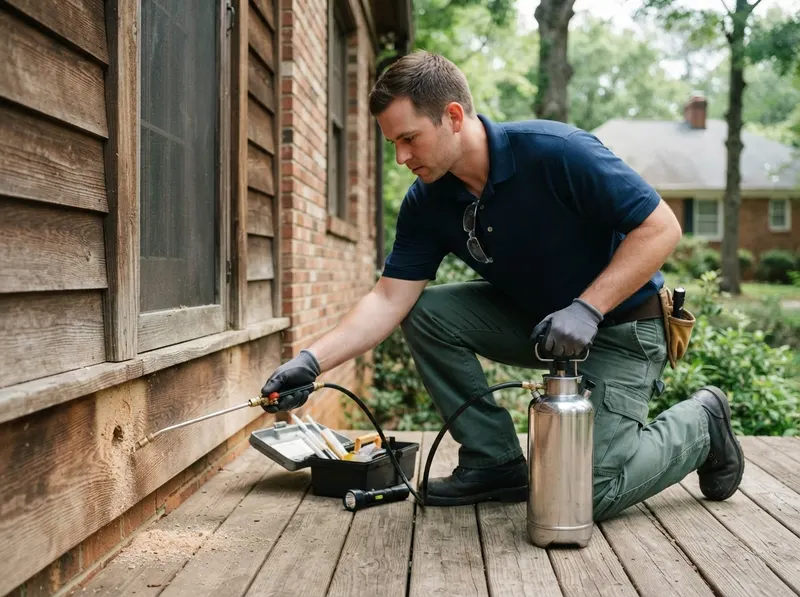
Older architecture throughout Highland Park, Forest Park, and Norwood features mature heart-pine and oak framing that frequently absorbs seasonal humidity from the surrounding Appalachian ridge. When moisture breaches crawl spaces, rooflines, or chimney flashing, carpenter ants hollow out structural timbers to carve smooth nesting galleries, while powderpost beetles turn interior support beams into fine, talc-like frass. A non-destructive electronic moisture meter pinpoints hidden galleries behind plaster and drywall before any drill-and-inject work begins. Targeted void treatments use transfer-effect active ingredients that foraging workers carry back to the reproductive queen, neutralizing the parent colony rather than scattering satellite pockets deeper into interior framing.
Properties bordering dense canopy lines near Vulcan Park or the shaded avenues of Crestline and Roebuck Springs face consistent re-infestation pressure from deadwood and tree canopies touching roof eaves. A standalone exterior barrier stops exterior foraging trails across stone foundations and brick piers. For light, localized foraging where wood remains structurally sound, a targeted perimeter-and-void knockdown solves the issue in a single focused intervention. For widespread larval infestations inside structural sills, subfloors, and joists near crawl spaces, localized non-destructive borate timber infusions are applied directly to the bare lumber to create an unpalatable chemical barrier against re-infestation.
The operational sequence executes in four measurable stages: 1. Full perimeter inspection measuring linear footage, foundation clearance, and exterior timber contact within 3 feet of soil. 2. Acoustic and thermal void scanning along damp perimeter walls to locate the central gallery without unnecessary exploratory demolition. 3. Direct micro-injection of non-repellent active agents into active nesting chambers and framing joints. 4. Application of an exterior liquid treatment extending 3 feet up the exterior foundation and 5 feet outward along the soil line. Treatments dry completely within 2 to 4 hours, after which indoor spaces remain accessible for family dogs and indoor cats without chemical tracking.
Every job gets a firm, written price after a free on-site visit.
Tell us about your carpenter ant & wood-borer defense job in Birmingham and we'll send a clear, written quote, usually the same day.
 BugBouncer Pest Control